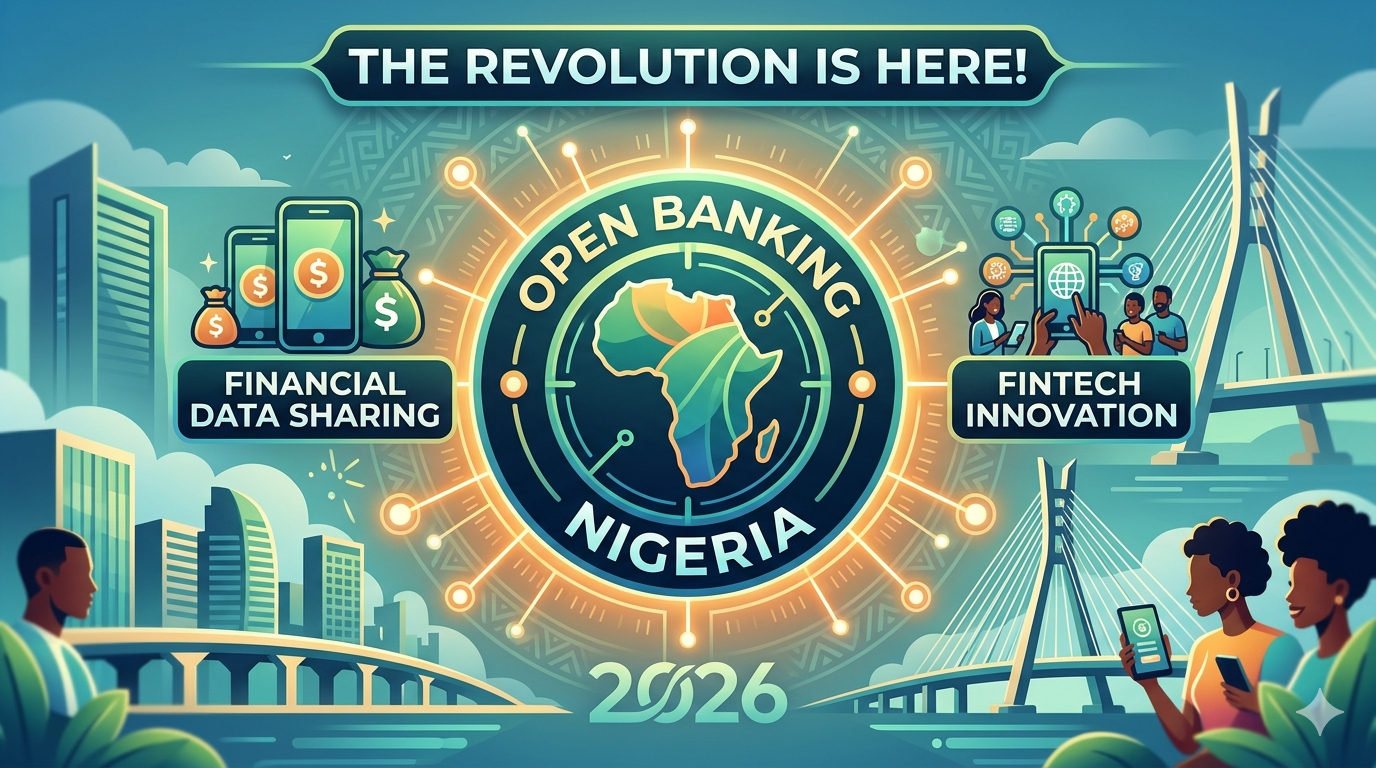
Nigeria's Open Banking Revolution Has Arrived — And It Changes Everything
Your bank no longer owns your money story. Here's how the CBN's boldest regulatory shift is rewiring Nigeria's financial system in 2026 — and what it means for your wallet, your credit, and your future.
40M+ — Nigerians gaining real-time credit access
99% — Digital payment success rate in 2026
1 tap — To share — or revoke — your financial data
Introduction
For decades, Nigeria's financial system operated like a collection of locked vaults. Your salary data sat inside GTBank. Your savings history lived in Zenith. Your UBA account whispered secrets no fintech app was ever allowed to hear. If you wanted a loan, you printed six months of PDF statements and prayed a loan officer believed the numbers.
That era is over. Permanently.
"In 2026, you own your financial data. Your bank is now a platform — not a gatekeeper."
As of April 2026, Nigeria has officially transitioned Open Banking from pilot to production, making it the most advanced Open Finance ecosystem on the African continent. This isn't a quiet regulatory memo. It is a seismic restructuring of the bank-customer relationship — one that hands power directly to you.
What Is Open Banking? (And Why Should Every Nigerian Care?)
Open Banking is a regulatory framework that requires licensed banks to share your financial data — with your explicit consent — with third-party providers through secure, standardised Application Programming Interfaces (APIs).
Think of it like giving a trusted app a controlled "read" on your accounts — not your password, not your PIN, just structured, permissioned data. An investment platform like Cowrywise can verify your income directly from your First Bank account. A lender like Carbon can analyse your real transaction history in seconds rather than weeks.
The data still belongs to you. You authorise it. You revoke it. The bank simply becomes the infrastructure, not the judge of who deserves credit or savings tools.
Why 2026 Is the Landmark Year Nigeria Has Been Waiting For
The CBN 2026 Fintech Report
The Central Bank of Nigeria moved Open Banking from "regulatory sandbox" to full production in February 2026, launching the Open Finance Lab (OFL) — a live environment where fintechs can deploy and stress-test data-sharing products safely before going to market.
The Rise of Agentic Finance
Nigerian fintechs now deploy AI agents that scan multiple bank accounts via Open Banking APIs simultaneously — hunting better interest rates, blocking unnecessary fees, and moving money with zero human intervention required.
The Fintech Trust Charter
The new Fintech Trust and Safety Charter, backed by the Nigeria Data Protection Act (NDPA), has replaced fear with standardised encryption and clear consent protocols — making Open Banking not just powerful, but genuinely safe.
5 Ways Open Banking Directly Benefits You Right Now
One dashboard. Every naira. Every bank. Financial aggregators now legally connect to all your Nigerian bank accounts — GTBank, Access, Zenith, UBA, First Bank — and display your complete net worth in one unified view. No more app-hopping or balance-guessing.
Instant credit scoring — no PDF statements required Open Banking allows lenders to analyse your real-time, live transaction history in seconds. The result: faster loan approvals, fairer interest rates, and a credit system that finally sees informal income earners and market traders.
Near-zero failed transfers By routing payments through direct bank-to-bank API calls rather than legacy card rails, Nigeria's digital payment success rate has hit an all-time high in 2026. The era of "transaction pending" and failed transfers is finally ending.
AI-powered personal finance — automatically Agentic finance tools now sweep your accounts to auto-invest spare change, dodge card maintenance fees, and redirect idle savings into higher-yield instruments — all without you lifting a finger or opening an app.
SME credit — finally unlocked Small businesses and sole traders who previously couldn't access formal credit due to "no collateral" can now consent to share verified cash-flow data. Platforms like Moniepoint and OPay are already lending at scale against this real data.
The Key Players Building Nigeria's Open Finance Infrastructure
Mono & Okra
The "pipes" of Open Banking — providing the secure API connectivity that links banks to apps. Without these infrastructure players, the entire ecosystem doesn't function.
CBN / Cardoso
Governor Olayemi Cardoso's CBN is architecting the entire regulatory framework — ensuring fintech innovation doesn't come at the cost of systemic financial stability.
Moniepoint & OPay
Nigeria's payment giants are leveraging open financial data to deliver hyper-personalised credit products to millions of retail users and SMEs across the country.
Cowrywise & Carbon
Consumer fintechs using Open Banking to automate savings, verify income in real time, and deliver micro-investments and instant credit at meaningful scale.
Is Your Data Actually Safe? The Question Every Nigerian Is Asking
The most Googled question in Nigerian fintech circles right now is: "Can someone access my bank account through Open Banking?" The answer, under the CBN Open Banking Framework, is a clear no — not without your explicit, informed, time-limited consent.
How Open Banking Consent Works
Think of it like "Sign in with Google" — but for your finances. You see exactly what data is being requested (balance only, or full transaction history), for how long access lasts, and which licensed company receives it. You can revoke access at any time, from any device, instantly. Every third-party provider must be CBN-licensed. The Nigeria Data Protection Act (NDPA) provides civil and criminal penalties for violations — making this far safer than the old model of sharing your actual bank login credentials with third-party apps.
The standardised encryption, consent dashboards, and the NDPA working in concert have transformed the risk profile of Open Banking from "terrifying" to "transparent and manageable" — a significant step forward in Nigeria's digital trust infrastructure.
The Bigger Picture: Financial Inclusion at National Scale
Open Banking is more than a convenience upgrade for tech-savvy Lagosians. It is Nigeria's most powerful financial inclusion tool since mobile money. By dismantling the data silos between banks and licensed fintechs, the CBN is creating a system where a market trader in Aba with consistent digital cash flow can access formal credit at competitive rates — something the legacy banking system structurally prevented for decades.
For Nigeria's Gen Z and millennial population — the most financially active demographic in the country — the "Open" era means your financial identity is portable, your data is an asset, and your bank no longer holds all the cards.
The walled gardens have fallen. The question is: are you ready to walk through the open gate?
Discussion
Be the first to leave a thought